Peak season promotions: how to stop panic wrecking your discount strategy

Every peak season, something shifts.
A bidding platform updates its algorithm. A competitor cuts prices overnight. Conversion rate dips for a week with no obvious cause. Whatever it is, the instinct is always the same: react now, fix it with a discount.
That instinct is usually the most expensive part of peak trading. The businesses that come out of BFCM and Christmas with their margin intact aren’t the ones who spot every wobble first. They’re the ones who can tell a real problem from noise, and only pull the discount lever when it’s actually needed.
Peak season makes this harder than any other point in the year. Traffic is higher, so small percentage shifts look bigger. Everyone is watching the dashboards more closely.
And the pressure to hit a revenue number makes “just discount it” feel like the safe choice, even when it’s the expensive one.
The panic reflex costs more than the discount
When a platform changes how it bids, performance data gets noisy for a while before it settles. Every past transition has followed the same pattern: accounts retargeted mid-change perform worse than those that hold steady and let the model learn. Panicking early doesn’t fix the problem; it adds a second one because the account is now reacting to noise rather than signal.
Promotional planning has the exact same failure mode, and the industry data shows it happening systematically, not just occasionally. RevLifter’s own Promotions & Loyalty Schemes report with IMRG, which tracked 35 retailers over two years, found a clear correlation between weak trading months and discounting activity: when year-on-year performance dipped, the share of revenue coming from discounted products rose right alongside it.
Retailers reach for the same lever every time performance wobbles, whether or not it’s the right one. Conversion rate softens, so a sitewide discount code is sent to everyone, including shoppers who were already going to buy at full price. The dip gets “fixed” on the dashboard, but margin protection goes out the window, and the business has just taught its best customers to wait for the next code before buying again.
This is how discount dependency starts. Not with one bad decision, but with a series of reasonable-looking ones made under pressure, each of which trains shoppers to expect an offer before they’ll convert.
By the time next peak season comes round, the baseline has moved, and the same promotional budget buys less incremental revenue than it did the year before.
Where the panic reflex shows up most
It’s rarely the headline discount code that does the damage. It’s the smaller decisions made in the moment: an exit-intent overlay that fires a bigger offer than planned because checkout abandonment ticked up on a slow Tuesday, a category page discount extended because one competitor cut prices, a free shipping threshold dropped mid-campaign because average order value looked soft for a day.
The maths behind those small decisions is brutal. Square’s own breakdown of discounting and profitability walks through a $100 item with a 40% gross margin: a 20% discount doesn’t just cost 20%, it halves the profit on that sale, from $40 to $20, meaning you’d need to sell double the volume just to land the same total profit. A reactive discount agreed in five minutes under pressure can quietly reset that maths across an entire category for the rest of peak season.
Stacked together across a promotional calendar, these small reactive decisions add up to a plan that was never actually a plan, just a string of reactions.
Three checks before you touch anything
This applies whether the lever is a bidding target or a discount code, and it’s worth building into your promotional calendar as a standing step rather than a one-off.
Is it affecting everything, or one part of it?
A dip in one campaign or one category during a known change is expected. A dip across your whole site is more likely to mean something. Segment before you react to the whole. If men's footwear is down but the rest of the site is flat, that’s a category issue, not a reason to discount every product you sell.
Does it match a pattern you’ve seen before?
Algorithms wobble after updates. Conversion softens on certain days or weeks every year, particularly the lull between big campaign moments. If last year’s data looked the same at this point in the calendar, this probably isn’t new information; it’s a pattern you already have on file.
What does a control group say?
This is the step most promotional plans skip, even though it’s standard practice everywhere else in performance marketing. If you can’t measure what happens without the discount, you can’t know whether it worked or whether those shoppers would have bought anyway. As Voucherify puts it in their guide to personalized promotions, high redemption is easy if you give away enough margin, so redemption alone isn’t proof of anything.
The real question is what changed as a result of the offer, and a control group is the only way to answer it.
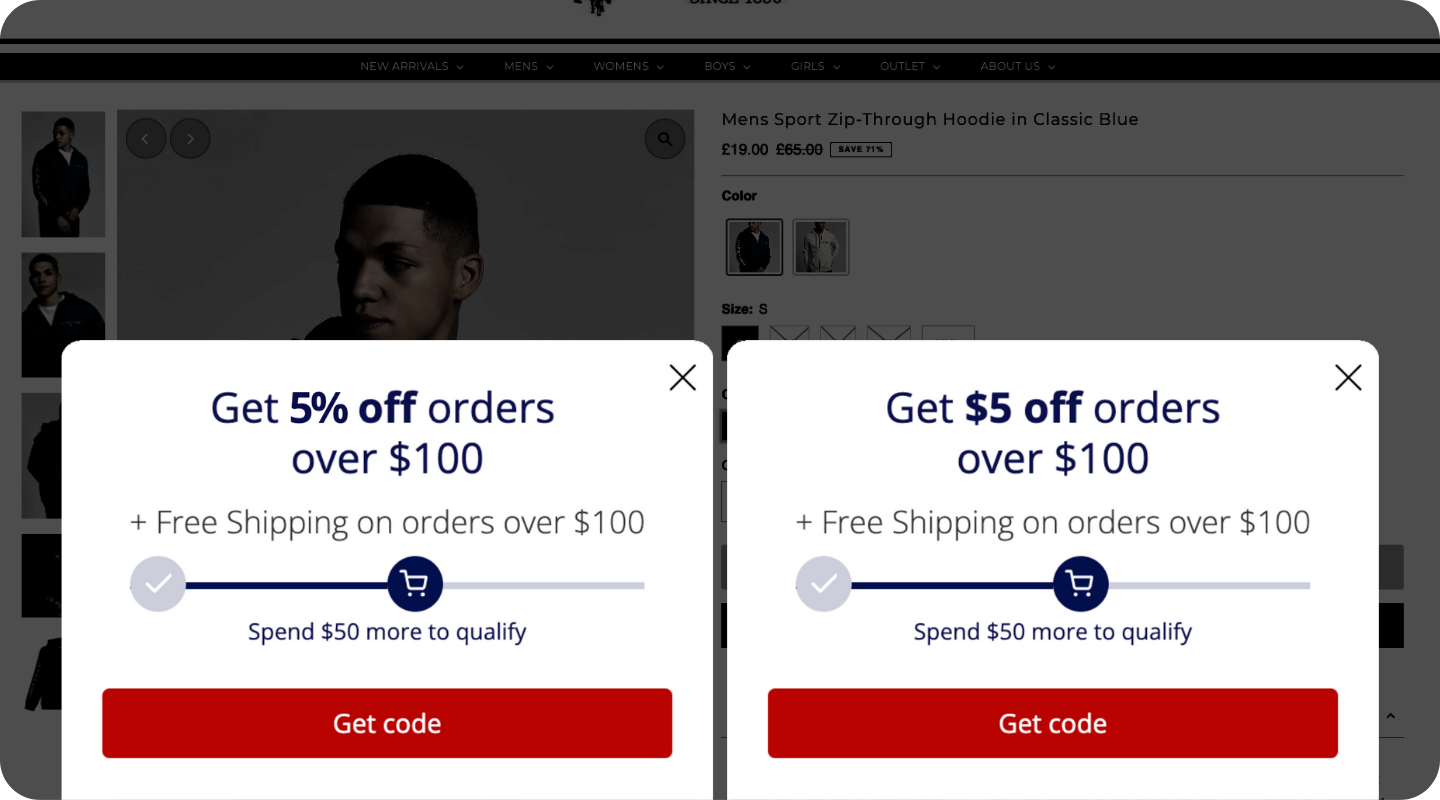
One of our retail customers, US Polo Assn, used this approach to settle a genuine question rather than a hunch: whether “$ off” or “% off” offers performed better in a Stretch & Save campaign. A straight split test showed that the difference between formats was small, but knowing that let them pick the more profitable option with confidence rather than guessing. That’s a control group doing its job, turning a debate into a decision.
Discounting isn’t the problem; blanket discounting is
In our response to Mark Ritson’s case against discounting, we argued that retailers operating on tight margins and with real stockrooms can’t simply stop discounting the way a brand owner might. But the rule still holds: never give away margin you didn’t need to give away. That means knowing who actually needs an offer to convert, and holding it back from everyone else.
Sportswear retailer SportsShoes is a good example of what that precision looks like in practice. Rather than dropping a wider discount when checkout abandonment was a problem, they used a Stretch & Save offer, a small incentive shown only to shoppers close to a spending threshold, alongside an exit-intent offer for genuine abandoners.

Tested properly, it delivered a 10% lift in revenue per user and a 6% rise in conversion rate, without discounting shoppers who didn’t need the nudge. It worked well enough to roll out across five European markets.
Peak season puts this discipline under the most pressure, because it’s the moment when every KPI is being watched closest, and the temptation to overreact is highest. It’s also the moment when getting it right matters most, because the volume of traffic means every percentage point of wasted promotional spend is worth far more than it would be in a quieter month.
Building panic-proofing into your peak season plan
A promotional plan that can survive peak season needs three things in place before trading starts, not once things start moving.
A benchmark for normal
Know what typical conversion rate, AOV and cart abandonment look like by channel and category, so you can spot a genuine shift instead of guessing. Without this, every number during peak season looks alarming because there’s nothing to compare it to.
An agreed threshold for action
Decide in advance what counts as a real problem versus expected noise, so nobody’s making that call under pressure in the moment. Write it down. If the conversion rate drops more than an agreed amount for more than an agreed number of days, that’s when the team acts, not before.
Control groups on every offer
Every promotion should be measured against a group that didn’t see it. That’s the only way to know whether an offer generated incremental sales or just gave away margin on purchases that would have happened anyway. This should run on every offer in the promotional calendar, not just the ones that feel experimental.
The businesses that win peak season hold their nerve
Peak trading rewards restraint more than speed. The strongest promotional strategy isn’t the one with the fastest trigger finger; it’s the one that can tell the difference between a real signal and a wobble, and only discounts where it counts. That restraint is hard to build in the moment under pressure, which is exactly why it needs to be part of the plan before peak season starts, not something the team figures out on the fly.