AI traffic lands on your product page. Is it ready?
For most of eCommerce's history, the path from discovery to purchase was messy.
A shopper would Google something. Land on a homepage or collection page. Filter. Click into a product. Go back. Check another. Read the about page. Look for delivery info. Head to cart. Eventually checkout.
Round and round and round.
It was rarely linear. But it worked, because every step added context. By the time someone reached your product detail page, they already knew who you were. The homepage explained the brand. The category pages framed the range. The about page had done the story.
Your PDP just had to close.
But now, that's changing.
What the data shows
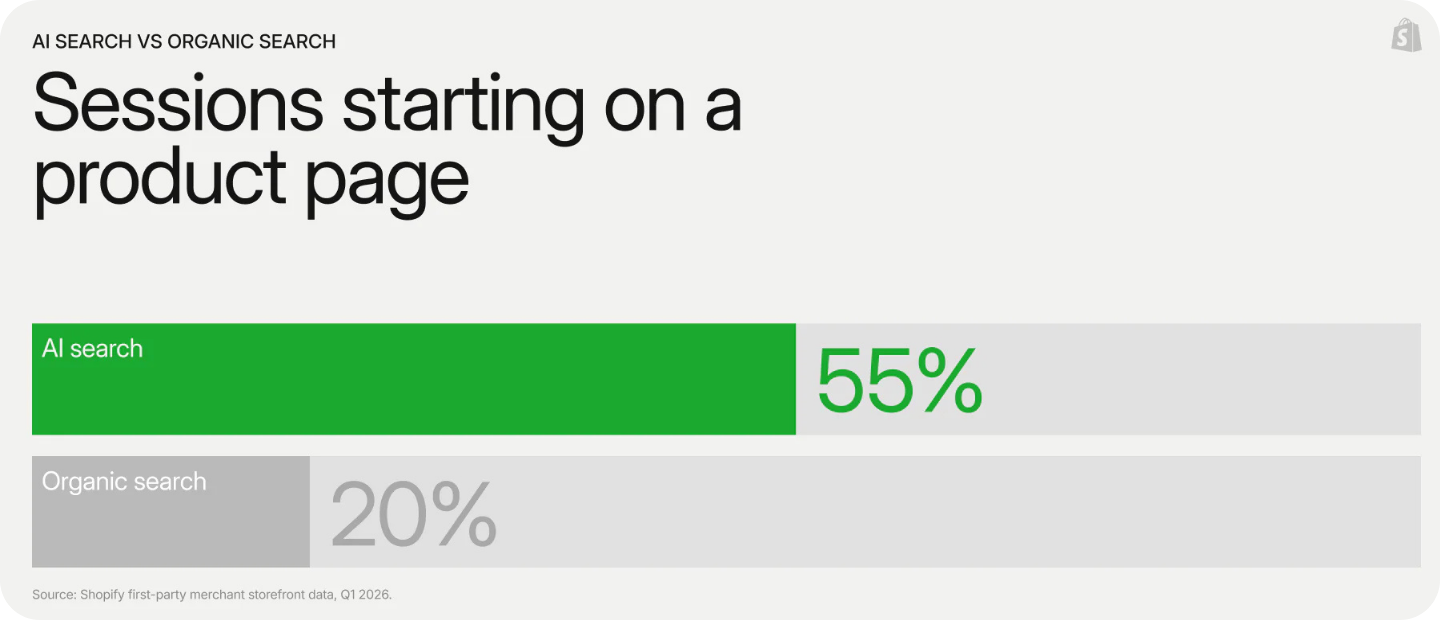
Shopify's Q1 2026 AI search data shows a significant shift in how traffic arrives on site.
55% of AI-referred sessions started directly on a product detail page, compared with around 20% for organic search.
And these visitors convert.
AI-referred shoppers converted at nearly 50% higher rates than organic search visitors on product-page sessions. Their orders also carried 14% higher average order value.
That sounds like good news. It is. But it comes with a catch.
Why this is happening
AI assistants don't recommend stores. They recommend products.
When someone asks an AI what running shoes suit wide feet and long distances, they don't get "try SportsShoes." They get a specific product, sometimes with a comparison, and a link to buy it.
By the time the shopper lands on your PDP, they've already done the research.
They've asked the question, weighed the options, and narrowed their choice. They're not in browse mode. They're in "is this the one?" mode.
That's why they convert more and spend more when they do.
The catch
The PDP is built to close warm traffic (traffic that had already moved through your site), which is now the first page a significant chunk of visitors see.
Think about what a typical PDP contains:
- product images
- A price
- A variant selector
- A reviews widget
- An Add to Cart button
- Maybe some bullet points
- Occasionally, a size guide
That's enough when the customer has come through the homepage and absorbed your brand along the way. But for someone arriving cold from an AI recommendation, there are gaps.
They may not know the brand at all, just that the AI recommended this product.
They may not know where this product sits in your range, or whether there's a better version they haven't found yet.
They may not know whether delivery is free, whether returns are easy, whether the sizing runs small, or whether the subscription can be paused.
They may not know why they should trust you over the next result.
The PDP used to be the closer. Now it's the whole store.
What AI-referred visitors actually need
Not more content. More of the right content.
Brand orientation
A brief signal that tells the visitor who you are and why it matters. Not a paragraph about your founding story. Something that earns trust fast.
Range context
Is this product entry-level, mid-range, or your flagship? Visitors arriving from AI recommendations often have no frame of reference for where the product sits.
Honest comparison
If you sell a similar product that might be a better fit, surface it. A visitor who buys the right product trusts you more than one who buys the wrong one and returns it.
Practical reassurance
Delivery cost. Return window. Sizing notes. These aren't page furniture; they're the questions your visitor is already asking.
Social proof close to the decision
Not just a star rating at the top of the page. Recent reviews, specific to the product variant, near the Add to Cart button.
Stock signals where they're real
If inventory is genuinely limited, say so. It's not manipulation; it's information.
What this means for your offer strategy
Here's where things get interesting.
Most eCommerce sites treat exit intent as a blanket trigger. Visitor moves to close the tab? Fire the pop-up. "Wait! Here's 10% off!"
For AI-referred traffic, this is a costly mistake.
These visitors arrived pre-qualified. They've already decided they're interested. The question they're asking isn't "should I buy?", it's "should I buy this, from you, now?" Showing them a discount when they're already close to converting is just a margin giveaway.
There's a useful parallel in loyalty program research. Members appear to have dramatically higher purchase rates than non-members, but the gap shrinks significantly when you account for the fact that heavy buyers are the ones who join loyalty programs in the first place.
The program isn't doing as much as it looks like. The intent was already there.
The same logic applies here. AI-referred shoppers convert at higher rates because they arrive with higher intent, not because your pop-up gave them the push they needed.
The right approach is not to offer. It's the right offer, for the right friction, at the right point. If someone is genuinely hesitating over price, a targeted incentive may help. If they're hesitating over trust or fit, a discount won't fix that, but a well-placed review or a clear returns policy might.
Knowing which visitors actually need an incentive (and which will convert without one) is where the margin is.
In summary
AI is changing where visitors enter your site, and who those visitors are.
They're arriving later in their decision journey, with higher intent, skipping the onsite path that used to warm them up for you.
That's good for conversion rates. It's a challenge for product pages that weren't built to carry the whole brand experience.
And it's a good reason to carefully examine where your offers are being served, because visitors who need them least may now be landing directly on your product pages.
Build the PDP that doesn't need the rest of the site. And save the offer for the visitor who actually needs it.