When to show an offer matters more than what offer you show

You might workshop discount percentages, test different promotional mechanics, and argue over whether 15% or 20% will drive more conversions. But the question that matters most isn't what offer to run.
It's who actually needs to see it.
At Pulse eCommerce Summit, Sian Wells from SportsShoes walked through what happened when they stopped giving everyone the same discount and started showing offers only to customers who genuinely needed them.
The shift wasn't complicated, but the margin impact was significant.
The problem: giving discounts to people who'd have bought anyway
Most people redeeming discount codes would have purchased at full price anyway.
Research from 2 Visions found that 62% of consumers wait for discounts before buying. When you run a site-wide offer, you're not just reaching those price-sensitive shoppers. You're also discounting for the 38% who were ready to pay full price.
Every customer who lands on your site sits somewhere on a spectrum between "definitely buying" and "definitely leaving."
The ones at the high-intent end don't need a discount. They've already decided. The ones at the low-intent end probably won't convert even with an offer.
The valuable group is in the middle: customers who are genuinely price-sensitive and need an incentive to complete the purchase.
Blanket discounting treats all three groups equally. You give away margin to customers who didn't need convincing, and you still lose the ones who were never going to buy.
The shift: from "what offer" to "who needs it"
The alternative is to stop asking "what promotional mechanic will drive the most conversions" and start asking "which customers actually need an offer to convert?"
That question changes everything. It means you stop broadcasting promotions and start responding to behavior. It means reading intent signals on your site and using those signals to decide who sees an offer and who doesn't.
This approach uses behavioral data to segment visitors in real time by their likelihood of converting. High-intent shoppers don't see offers. Price-sensitive shoppers do.
The system learns which signals predict conversion hesitancy and adjusts targeting accordingly.
The result: targeted interventions that appear only when a customer's behavior suggests they need a nudge, rather than blanket codes shown to everyone.
Real examples: SportsShoes campaigns
Exit intent campaigns
These trigger when someone shows signs of leaving the site, such as cursor movement toward the browser bar, rapid scrolling, or extended inactivity.
The offer appears as a lightbox with a simple message:
"Unlock 10% off! Treat yourself to Spring Summer '26 products for less."
But not everyone sees it. SportsShoes suppress the campaign if:
- Someone is already high-intent (multiple product views, basket activity, returning visitor)
- Products in the basket aren't valid for discounts
- The basket is empty
- Another promotional technology is already active (avoiding pop-up clashes)
They've also tested offer copy across markets. Urgency-driven messaging works in the UK. It doesn't land in France. So they adapt.

The Ctrl+C campaign
This one triggers when someone copies a product name on a product page.
Copying a product name is a clear signal of price-checking behavior. They're about to open a new tab, paste that name into Google, and start comparison shopping. If they find a better price elsewhere, you've lost them.
The Ctrl+C campaign intervenes at that exact moment. A lightbox appears with a 5% offer: "Don't go! Checkout today and get 5% off on Spring Summer '26 products."
It's a small discount, but it's targeted at the precise moment of price sensitivity. The customer is high-intent (they're on a product page, engaged enough to copy text) but also price-conscious (they're actively checking competitor pricing).
The 5% offer is enough to keep them on the site and convert them before they comparison-shop.

Invalid code campaign
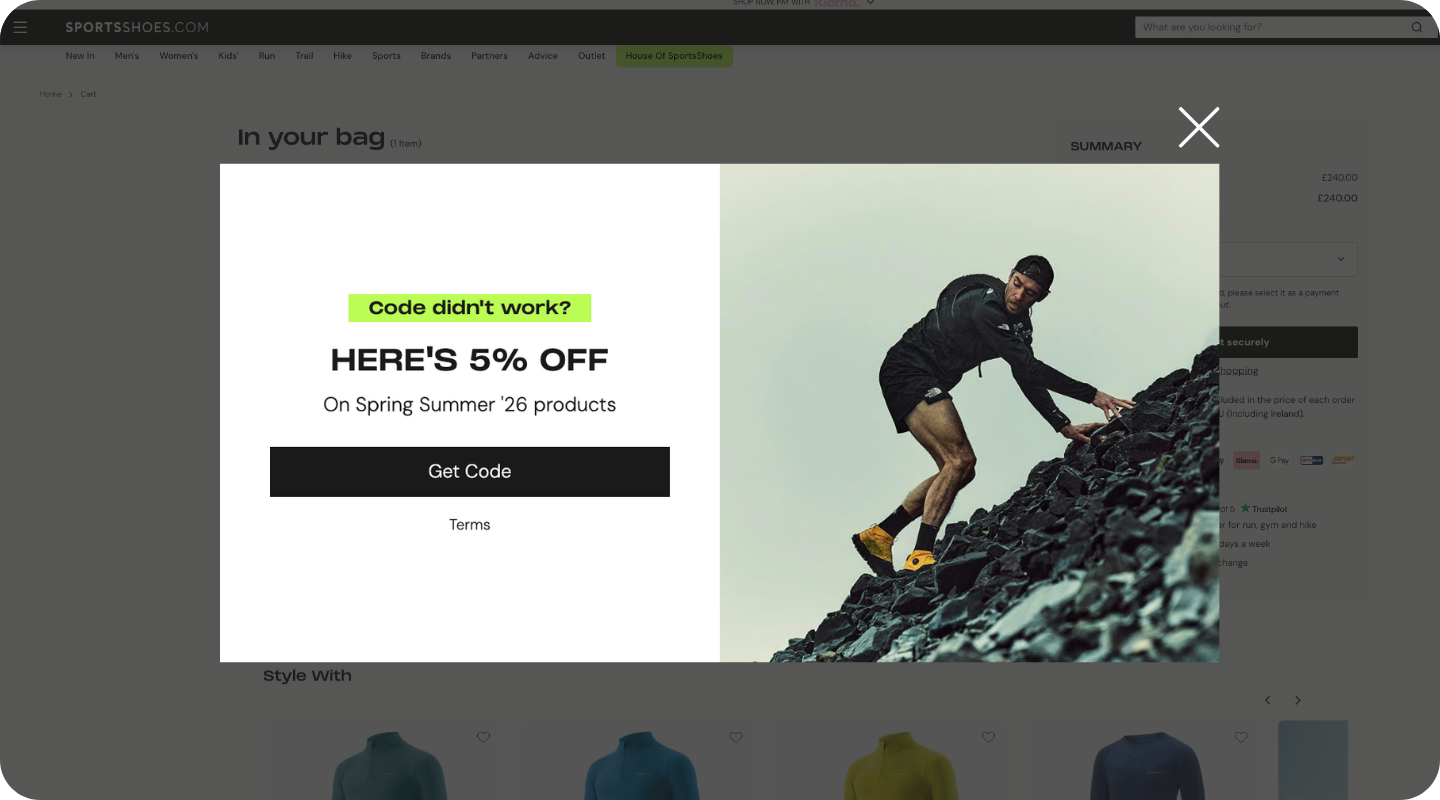
This triggers when someone enters an invalid discount code at checkout.
The behavior tells you what you need to know. They're trying to find a discount. They're price-sensitive. They're also already at checkout, which means they have high intent. Letting them leave to search for a working code is a missed opportunity.
The campaign shows a lightbox with a working 5% code: "Code didn't work? Here's 5% off on Spring Summer '26 products."
Simple. Targeted. Effective.
Seasonal sale campaigns
These promote specific sale categories using urgency to drive action. "Sale selling fast! Bag your kit now."
But even here, targeting matters. SportsShoes test copy by market (urgency messaging performs differently across regions) and suppress the campaign for customers who don't need it.
The pattern across all of these campaigns is the same: read the signal, respond accordingly, suppress when unnecessary.

The unlock: intent signals tell you when a discount will actually change behavior
Customer behavior on your site contains all the information you need to predict who needs a discount and who doesn't.
Someone who lands on a product page, adds to the basket, and heads straight to checkout is high-intent. Discounting them wastes margin.
Someone who copies a product name, opens multiple tabs, or tries multiple discount codes is price-sensitive. They need an incentive.
Someone who hovers over the exit button or sits idle for 90 seconds is at risk of abandoning. An intervention might save the sale.
These signals are visible in real time. The challenge is building systems that can read them, segment visitors accordingly, and trigger the right response at the right moment.
That's what intelligent targeting does. It moves promotional strategy from broadcast to response. From "everyone gets 15% off" to "this person gets 10% because their behavior suggests they need it, and this person gets nothing because they were buying anyway."
What changes: margin protection, smarter promotional spend, incrementality focus
When you stop discounting customers who don't need it, three things improve.
Margin protection becomes measurable
You're no longer giving away 15% on every transaction. You're selectively applying smaller discounts to customers who genuinely need them. The margin you save on high-intent customers' funds can be used to offer slightly deeper discounts to price-sensitive customers. The overall promotional cost drops.
Promotional spend gets smarter
You stop treating your promo budget as a blanket cost of doing business and start treating it as a targeted conversion tool. Every dollar spent on discounts goes to a customer whose behavior suggests that the discount will change their decision. Waste drops. Incrementality rises.
Incrementality becomes the focus
The question shifts from "how many conversions did this promotion drive?" to "how many of these conversions wouldn't have happened without the promotion?" That's a harder question to answer, but it's the right one. And when you target based on intent, you have a much clearer line of sight into true incrementality.
That's the shift. From broadcast to targeting. From "what" to "who."