Smaller discounts convert better, but that’s only half the story
The bigger the discount, the bigger the response. It is a tidy theory. And it’s mostly true.
But it’s not always what the data shows.
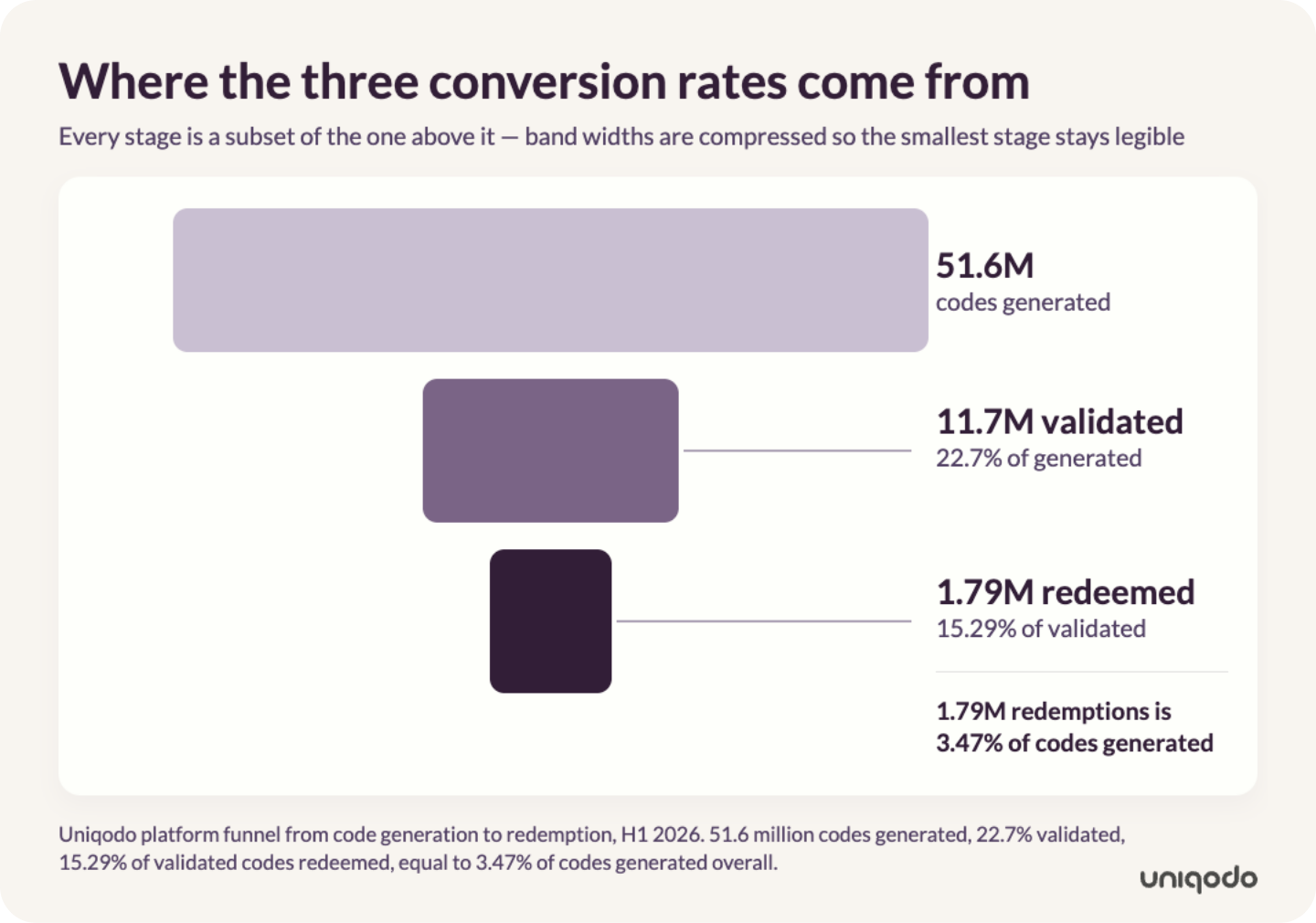
Uniqodo looked at 1.79 million code redemptions across 90 merchants between January and June 2026. In retail and fashion, this is what happened:
- 10% or less: 22.30% of validated codes were redeemed
- 15%: 15.26%
- 20%: 9.08%
- 25% or more: 13.67%
"Validated" means a shopper entered a code that was applied to a live basket.
"Redeemed" means they went on to make a purchase.
So these numbers reflect shoppers who actually completed a purchase after using a code, not the overall website conversion rate.
Even so, the gap is big. Codes worth 10% or less were redeemed more than twice as often as codes worth 20%.
And, awkwardly, the 20% tier had the most redemptions across the entire retail dataset (162,467). It also had the lowest conversion. Lots of retailers are picking the one that works least well.
What might be going on
This is our read, not Uniqodo's.
A shopper who is ready to buy does not need much persuading. A small nudge will do.
A deeper code can also attract shoppers who were comparing prices, hunting for a code or waiting for a better deal. They apply the code. They do not always buy.
So the bigger discount is not only costing you more per sale. It may be reaching people who were never going to be easy sales in the first place.
What does it do to your cost per order?
Here is a simple example. Let’s assume the same £130 basket in both cases.
- Take 100 shoppers who apply a 10% code. About 22 go on to buy. Each code costs £13, so you pay about £13 per order.
- Take 100 shoppers who apply a 20% code. About 9 go on to buy. Each code costs £26, so you pay about £26 per order.
The same basket, double the cost per order, and fewer orders.
Real baskets will differ, and that matters (more on that in a moment). But the direction is hard to argue with. A deeper discount has to earn its extra cost, and in this data, it mostly didn't.
But before you cut every code to 10%
A few things to keep in mind:
It is a single dataset covering travel, retail, fashion, and telco over a six-month period. Uniqodo reports that smaller discounts came with lower average order values. Higher conversion on a smaller basket is not automatically a win.
Travel flips the pattern - at 30% or more, 71.77% of validated travel codes were redeemed.
A percentage is also not a price. As Uniqodo's sector-by-sector analysis points out, 10% off a £130 fashion basket is £13. 15% off a £2,778 holiday is over £400. Same number on the banner, very different thing in the shopper's head.
Retail peaked at the low end. Travel peaked much higher. Neither is wrong. They are different shoppers making different decisions.
The real lesson is who, not how much
There is no magic discount depth. The right size depends on the shopper in front of you.
Someone about to buy anyway needs a small nudge, or nothing at all. Someone drifting away might need more.
A blanket 20% overpays the first shopper and may not move the second. (Both lose, and one of them is your margin.)
This is not a new problem. Nielsen estimates that around 84% of price promotions are unprofitable, a figure Les Binet has cited as a reason for caution. BCG puts it at 30 to 40% of retail promotions being either inefficient or unprofitable.
The fix BCG points to is the same one the Uniqodo data hints at. BCG's research on personalised offers found they are at least twice as effective as average mass promotions in most categories. We wrote about what that means for retailers here.
Put simply, the question is not "10% or 20%?" It is "does this shopper need an offer at all, and if so, how big?"
A redeemed code is not an extra sale
Treat this data as a prompt to investigate and test, not a rule to follow. Your shoppers are not Uniqodo's average shoppers.
If your 20% code is your best performer, that is worth knowing. But ask one more question: would those shoppers have bought anyway? A redeemed code only tells you someone used a discount. It does not tell you the discount that made them buy.
That second question is the hard one. It is also where most of the margin hides.
Why now
Black Friday is less than eight weeks away. It is when blanket codes tend to get deeper, and when everyone is tempted to match the biggest number on the high street.
It is also when you have the most traffic to learn from. Better to know which discount depths are earning their keep before the rush, not after it. (Hindsight is lovely, but it does not recover margin.)
Three things worth doing
- Pull the redemption rate by discount depth for the last six months. Ignore total revenue for a moment.
- Add margin per order to the same view. A code that converts better and costs less is the one to look at first.
- Pick one customer segment and test a smaller offer. Keep your usual offer running alongside it.
None of this needs new tools. It needs a spreadsheet and an afternoon for comparison.
The banner number is the easy part
Picking 10% or 20% takes a minute. Working out who needs it takes longer. (Which is probably why so many of us stop after the first bit.)
The Uniqodo data cannot tell you your best discount. It does tell you that the biggest one is rarely it. That is useful to know, and cheap to check.
So pull the numbers this week. Your 20% code may be doing a lot less than you think. Better you find that out than your margin.