Peak season shoppers don’t want your discount - they want proof it’s worth it

Our previous two articles on Peak season have focused on two things:
- Stop panic discounting when a bad week rattles you.
- Stop giving the same offer to everyone when only some people actually need it.
Here’s the bit we’ve been building to.
Even when a discount is the right call, price alone is losing its grip on the decision. Something else has taken its place, and it’s worth understanding before you finalise your peak season plan.
In Peak season, the old playbooks of blanket discounts and price-driven campaigns are rapidly losing effectiveness. Peak is no longer about racing to the bottom. It’s about understanding the new calculus of value: price may get your product into the consideration set, but it rarely closes the sale.
Today’s shoppers (especially the most digitally fluent and brand-savvy segments) demand tangible proof that a product is worth the spend, not just a lower number on the tag.
The 67% problem
Start with this: 67% of consumers say they won’t buy something they can afford if it doesn’t feel worth the money. BCG has tracked a version of this figure since 2022, and it’s remained at roughly 70% throughout. This isn’t just a blip; it’s a pattern.
For most shoppers, value is a multidimensional calculation. It’s rarely just about price. Instead, consumers weigh a mix of rational factors, such as durability, ingredients, and product features, against emotional signals, such as brand trust, social proof, and perceived quality.
Price influence is declining fastest in the categories that relied on it most. Apparel is down 12% year over year. Beauty is down 13%.
BCG puts it simply: “Price determines whether a product enters the consideration set. But once that threshold is met, the basis for the ultimate decision quickly shifts to value.”
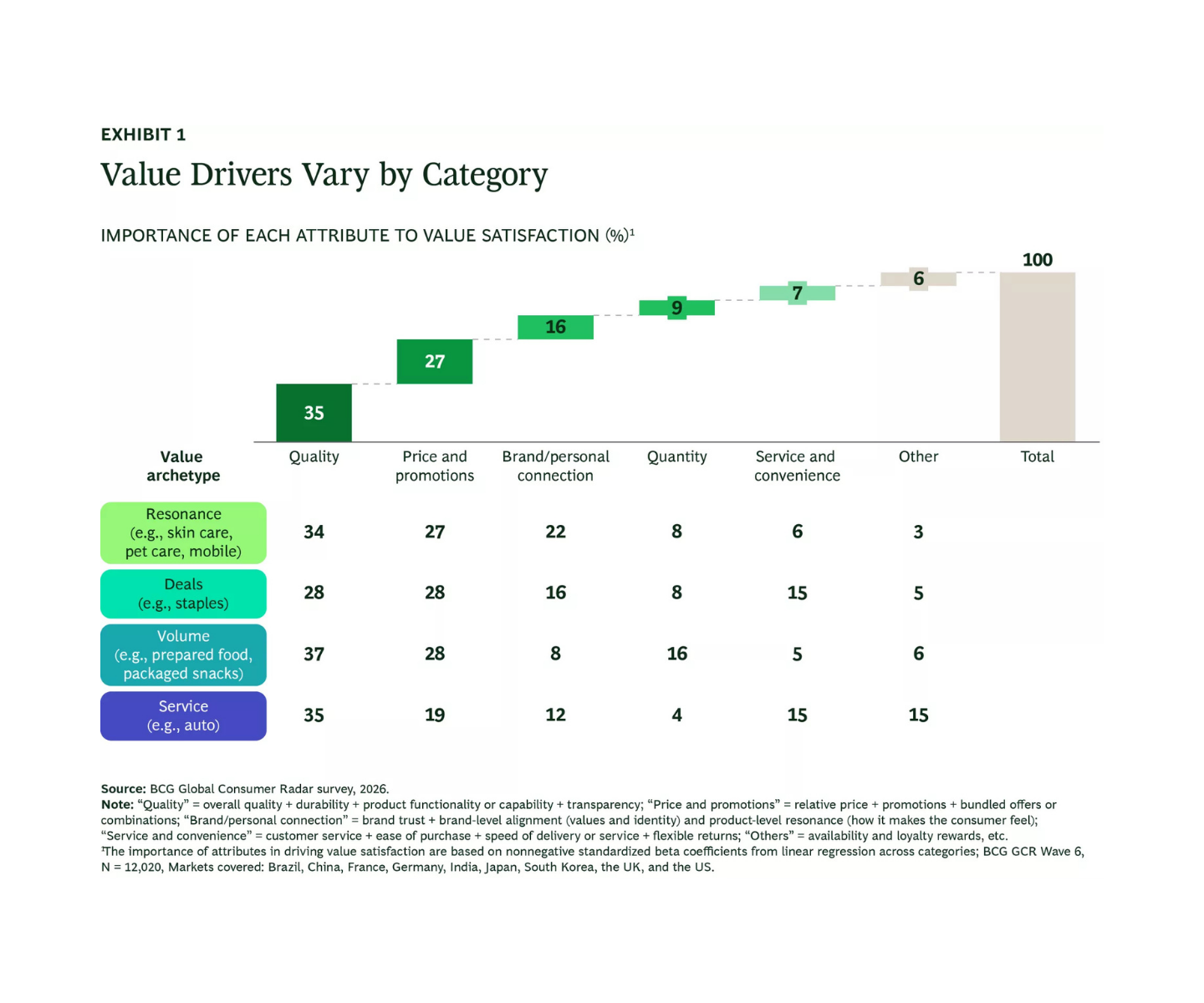
Price gets you in the room. It doesn’t close the sale on its own anymore.
Price isn’t even in the top five
Here’s the stat that should reshape how you plan promotions this peak season.
When Salsify asked shoppers what actually signals quality and value, price came fifth. Behind durability (54%), reviews (47%), brand reputation (45%), and transparency about materials or ingredients (42%). Only 35% ranked competitive pricing as a meaningful factor.
A discount is one lever. It’s just not the one shoppers reach for first anymore.
There’s a stranger stat sitting behind all this. Medallia found that two out of three consumers would have happily paid more than they actually did on their most recent purchase. Read that twice (please). Most shoppers weren’t hunting for the floor price.
They were checking whether the price matched what they were getting, and many would have accepted a higher price.
Quality is now a baseline, not a differentiator
BCG’s research revealed something worth considering: quality is no longer a way to stand out. It’s the price of entry now, and everyone’s expected to clear it. The real gap has shifted to convenience, service, and the personal nature of the experience.
That gap is bigger than most brands think. Despite how much consumers say value matters, only 14% of the 1,000+ brands BCG analysed consistently win on value perception. Most brands are chasing a metric they’re not actually competing on.
Salsify’s research backs this up from a trust perspective: 67% of shoppers say quality and value build their trust in a brand, and 68% say they’ve paid more for something specifically because they trusted the brand behind it.
Trust isn’t sitting quietly next to price as a nice-to-have. For most shoppers, it’s doing the actual deciding.
The trouble with treating a discount as your value signal
Here’s where it gets uncomfortable for anyone whose peak season plan starts and ends with “20% off.”
A discount is an easy way to feel like you’ve addressed the value question without actually addressing it. Les Binet, who has spent his career studying marketing effectiveness, called price promotions “the crack cocaine of marketing.”
His argument: the sales spike a promotion creates looks powerful, but a chunk of it is just subsidising shoppers who’d have bought anyway, a chunk is sales pulled forward from next week, and a chunk is cannibalised from another channel or store. What’s left, once you strip that out, is a lot smaller than it looked on day one.
Nielsen puts a number on the fallout: roughly 84% of price promotions turn out to be unprofitable once that maths is done. A discount can look like proof of value on a dashboard for about a week. To the shopper, it isn’t proof of anything. It’s just a lower number.
What actually reads as value at peak
You don’t need to guess at what works. There’s a good example from outside apparel that shows what happens when brands lean on specific, checkable claims instead of a blanket price cut. In pet care, products carrying claims like “human-grade protein” saw sales lift 42%. “Freshly cooked” lifted sales 92%.
No discount required. Just a specific, provable reason to believe the product is worth what it costs.
This matters even more with Gen Z, who are both your most price-sensitive shoppers and your most urgency-responsive ones. According to a Ryder study, discounts sway 61% of them on a first purchase, and 46% say a limited-time offer genuinely creates urgency. But urgency only works when it’s attached to something true.
Artificial scarcity on a product with nothing else going for it just trains them to wait for the next one.
Where does this leave your peak season plan?
You don’t need to abandon discounts. You need to stop treating a discount as your only value signal and get honest about who actually needs one to convert.
That’s the part we’ve already written about: stop panic wrecking your discount strategy, and get more from the same promo budget by targeting instead of blanketing.
What this piece adds: for shoppers who don’t need a price cut to convert, what moves them is proof, not a percentage off. Reviews, specifics, transparency, and a reason to trust the brand. Save the discount for the ones genuinely on the fence, and let the rest of your site make the value case for everyone else.
- Don’t panic.
- Don’t waste budget on people who would have bought anyway.
- Don’t confuse a discount with the reason someone actually chose you.