Redemptions are the wrong metric for your discount codes

The redemption rate seems like the obvious way to judge a promotion. A code goes out. People use it. Revenue comes in. Job done.
But that number hides the one thing you actually need to know: who would have bought anyway.
If you run promotions for an eCommerce brand, this single blind spot could be costing you margin on every campaign you send.
Three numbers, one story missing
Most promotion reports track three counts: impressions, clicks, and redemptions.
Each tells you something. No one tells you the thing that matters most: did the discount actually change anyone’s mind?
Impressions show reach. Clicks show interest. Redemptions show who used the code.
None showed you who needed it.
A shopper who was always going to buy that jacket still counts as a redemption. So does the shopper who was on the fence and needed $10 off to say yes.
Your report treats them the same, but your margin doesn’t.
What promotional sensitivity means
The gap between those two shoppers has a name: promotional sensitivity. It’s how much of a nudge a shopper needs before they buy.
Some shoppers convert the moment they land on your site. They’ve already decided. A discount is a bonus on a sale you were getting anyway.
Others are comparing options across tabs. They’re waiting for a reason to pick you. A well-timed offer can be that reason.
Treat both groups the same, and you get two kinds of waste: margin given to shoppers who didn’t need convincing, and hesitant shoppers who never got the nudge that would have closed the sale.
Not every shopper needs convincing
Most discounting strategies assume that price is the barrier for everyone. So they offer the same incentive to everyone.
That’s rarely true.
Capital One Shopping found that 62% of clothing shoppers delay a purchase until they find a discount code. Flip that stat around: roughly 38% don’t need one at all. Give them a code anyway, and you haven’t won a sale. You’ve given away margin on one you already had.
Most customer bases are split into three rough groups:
Always-buyers. They’ll purchase at full price. A discount here is pure margin loss.
Fence-sitters. Interested, but the price or a competitor’s offer is holding them back. This is where a code earns its keep.
Discount-only shoppers. They only buy when there’s an offer, on this purchase or the next one. Worth watching for habit-forming, not just conversion.
One blanket code can’t tell these groups apart. It pays out equally to all three.
A recent Chain Store Age study reached the same conclusion: one discount no longer fits every shopper.
Why the redemption count misses this
A campaign with a strong redemption rate can still be a bad campaign.
If most redemptions came from shoppers who’d have bought at full price, you paid for permission to discount your best customers.
Nielsen research reported by Marketing Week found that around 84% of price promotions lose money once you weigh the margin given away against the sales they actually created. Warc covered the same finding.
Redemption counts, can’t see that loss. They only count those who used the code, not what it cost to hand it out.
A quick example
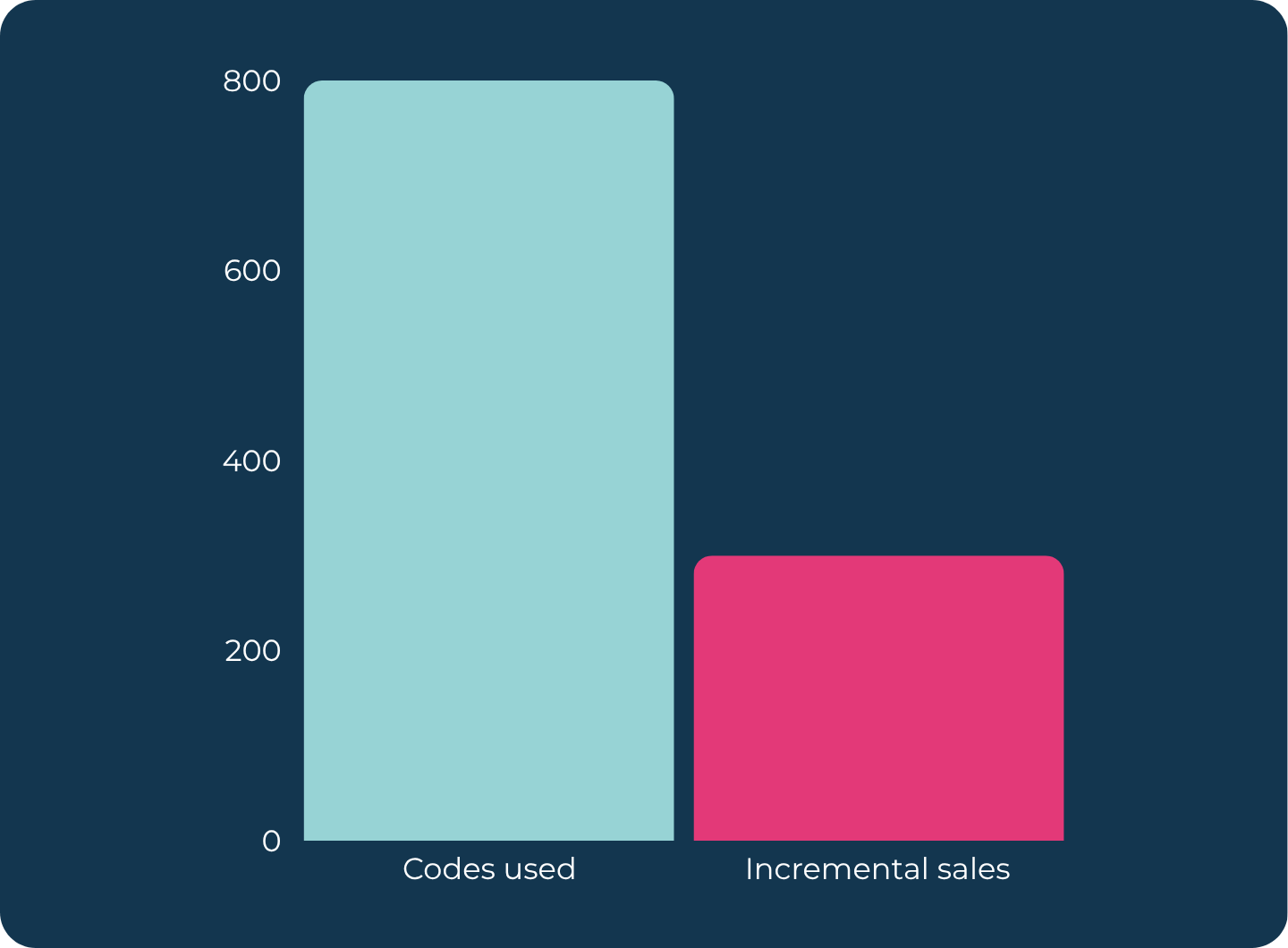
Say a campaign sends a 15% off code to 10,000 shoppers, through a Klaviyo email flow or an on-site pop-up. 800 redeem it. That’s an 8% redemption rate, which looks solid in the weekly report.
Now, split those 800 by whether they’d have bought anyway.
If 500 were always-buyers, you would discount every one of those purchases for nothing. The sale and the full-price revenue were already in the pipeline.
Only the remaining 300 needed the conversion code. Those are the redemptions worth celebrating.
A standard redemption report will never separate the two.
What to measure instead
Redemption rate isn’t useless. It’s just incomplete. Pair it with:
Incremental lift
Would this sale have happened without the discount? A holdout test is the most reliable way to find out. Hold the offer back from a small, comparable group of shoppers and compare their conversion rate to the group that saw it. The difference is your real lift, not the number in the redemption column.
Margin per redemption
Not just revenue, but what’s left once the discount comes off. A campaign can grow revenue while shrinking profit.
Segment performance
Is the code converting hesitant shoppers, or subsidising confident ones? Break redemptions down by new versus returning customers. Always-buyers usually stand out fast.
Putting this to work
You don’t need a full rebuild to start. Three steps:
- Run a holdout group on your next campaign, even a small one, so you have a real lift number to compare against the redemption rate.
- Tag redeemers from your last three campaigns as new or returning customers. Returning customers with a long purchase history are your likeliest, always-buyers.
- Flex the offer where you can. Full price, or a smaller nudge, for shoppers already showing strong intent. A stronger code for shoppers who are hesitant.
This works whether you’re running promotions natively on Shopify, BigCommerce, or another eCommerce platform. The mechanics of personalizing an offer by segment stay the same.
Why this matters
Getting this right is about more than a tidier report.
- More profit per customer. You stop subsidising sales that were already happening.
- Better use of promotion budget. Spend goes to shoppers who need the nudge, not to those who don’t.
- Sharper personalisation. Offers start reflecting real buying intent rather than a blanket rule.
The takeaway
A discount code isn’t a success just because someone used it. It’s a success if it changed a shopper’s mind.
Those are two different things. Only one shows up in a standard redemption report.
Before your next campaign, ask a harder question than “how many people redeemed this.” Ask who redeemed it, and whether they needed to.